
Advanced AAC plant equipment manufacturer in India
- Home
- About Us

We’re a global award wining company
An Advanced AAC Plant Equipment Manufacturer in India-Your Profound Guide
Autoclaved aerated concrete (AAC) has already pushed its way into the Indian construction industry because it is light, durable, and eco-friendly. It is manufactured with natural raw materials, granting AAC excellent thermal insulation, soundproofing, and fire resistance, thus rendering it a favorite construction material for modern projects. There is no doubt that as the demand for green and energy-efficient construction materials grows, the demand for advanced AAC plant equipment has similarly gained great importance. These machines ensure the utmost accuracy and high production efficiency while maintaining consistent quality in every block produced. Most importantly, as the Indian construction industry switches over to green building solutions, investing in advanced AAC manufacturing technology has put India on the fast track towards sustainable and economical infrastructure development.
We’re a global award wining company
What is AAC and Why It Is in Demand?
Autoclaved Aerated Concrete (AAC) is a lightweight, precast building material comprising cement, lime, fly ash, water, and an aerating agent. The cellular structure bestows excellent thermal insulation, sound absorption, and fire-retardant properties upon AAC. AAC blocks, in comparison with conventional clay bricks, are light, are more manageable, and vastly decrease construction time and cost. Due to its eco-friendly and energy-efficient nature, AAC is fast becoming a preferred construction material for sustainable building projects. The demand for AAC in India is thus soaring in residential, commercial, and industrial projects due to the requirement for building materials that are durable, cost-effective, and able to sustain modern infrastructure requirements.
Role of Advanced AAC Plant Equipment in Production
Production Process of AAC
An elaborate and still-more-prolonged process of production changes raw materials to lightweight, durable blocks.
- Raw Material Preparation: Cement, lime, and sand are all raw materials that are carefully measured and prepared. The sand is then finely grinded using the ball mill method into a slurry. The ball-milling gives a uniform size of the fine particles, which is necessary for later-occurring chemical reactions.
- Mixing and Casting: The prepared materials are mixed in an industrial mixer. Aluminum powder, which serves as the foaming agent, is added at this point. When the powder reacts with alkaline components in the slurry, it liberates hydrogen gas, and the entire mixture swells and rises like cake batter. The mixture is now poured into big steel molds.
- Pre-curing and Cutting: The mixture is left to pre-cure for some hours in the molds. During this phase, hydrogen gas escapes, and the mixture solidifies into what is referred to as a “green cake.” The strength of the green cake is maintained so that it can be wire-cut using steel wires. All the necessary cutting is achieved by means of mechanized cutting machines that accurately cut the large cake into blocks or panels, ensuring dimensional precision.
- Autoclaving: The green-cut blocks are put onto trolleys and transferred to a large, pressurized chamber called an autoclave. Inside the autoclave, steam is applied at high pressure and maintained at a temperature of around 180190 for up to 12 h, during which the strength and stability of the product are imparted. It is during this process that the crystalline structure of the blocks is generated, giving them their special lightweight characteristics.
Automation and Advanced Engineering
Automation and advanced machinery are critical for the AAC production process to make it precise and efficient taking into consideration factors such as computerized control over everything including the raw material mixing ratios to the autoclaving cycle. The systems put in place guarantee the avoidance of human errors, thus ensuring consistency with case examples including automated dosing systems confirming exact amounts of each raw material, while robotic cutting machines provide perfect block dimensions that reduce production time, labor costs, and resource optimization.
Ensuring Quality, Reducing Waste, and Saving Costs
Advanced equipment is very vital in ensuring that product quality is consistent. It guarantees that the chemical composition of the AAC mixture is accurate all times, thus directly influencing the strength and durability of the end product. Automated cutting systems prevent warping and structural problems encountered during construction as blocks will be produced of accurate dimensions. This kind of accuracy helps in minimizing waste from the material since less will be lost due to an incorrect cut or unusable blocks. However, efficiency and waste savings provided by modern machinery translate significant savings in money, thus making the end product much more viable.
Types of AAC Plant Equipment
- Ball Mill: It grinds raw materials such as lime, sand, and gypsum into a very fine powder. This fine powder helps the chemical reaction to be correct and consistent, which is necessary during the production of AAC.
- Jaw Crusher: This is used for the initial stage of crushing large raw materials as quicklime and then take them to the ball mill to be further ground. The material comes down to a size that is confidential, and this makes the process of milling more efficient.
- Jaw Crusher: This is used for the initial stage of crushing large raw materials such as quicklime and then taking them to the ball mill to be further ground. The material comes down to a size that is confidential, and this makes the process of milling more efficient.
- Silo: Silos are essentially large containers used to store raw powdered materials, such as in the case of cement, fly ash, and quicklime, after it is processed. It gives the mixing unit a permanent supply of ingredients for smooth production.
- Weighing and Batching System: An automatic dispensing machine that measures and releases the exact amounts of each raw material, including water and aluminum powder. This is important to maintain the correct chemical balance and achieve the quality of AAC blocks.
- Batch Mixer: In this large mixer, weighed raw materials and mixed water rapidly create an amalgam that forms a slurry. It is now poured into molds where a chemical reaction initiates.
- Moulds and Cutting Machine: The mixer taps the energy of the slurry fills into the molds, which rise like a cake as a result of gas-forming reaction. Once set, the material, now termed as “green cake,” is cut into specific blocks or panels using a typical cutting machine, massively using steel wires.
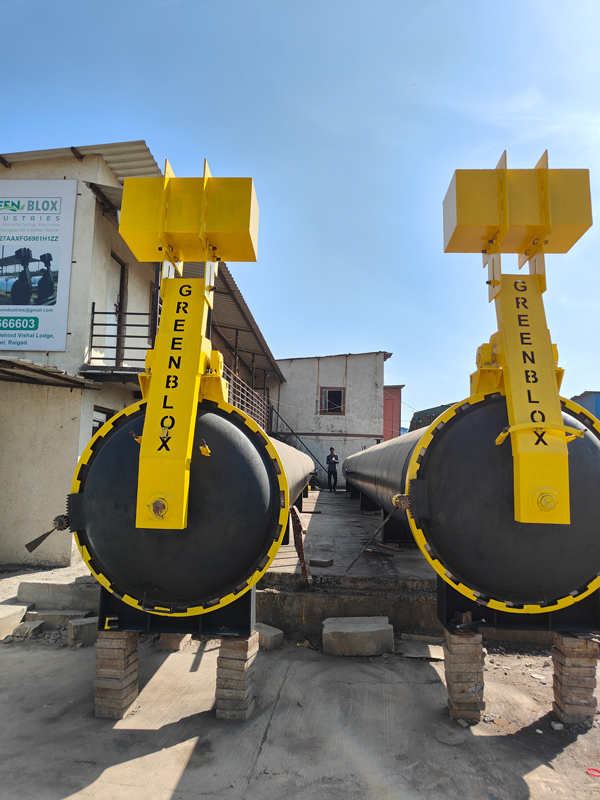
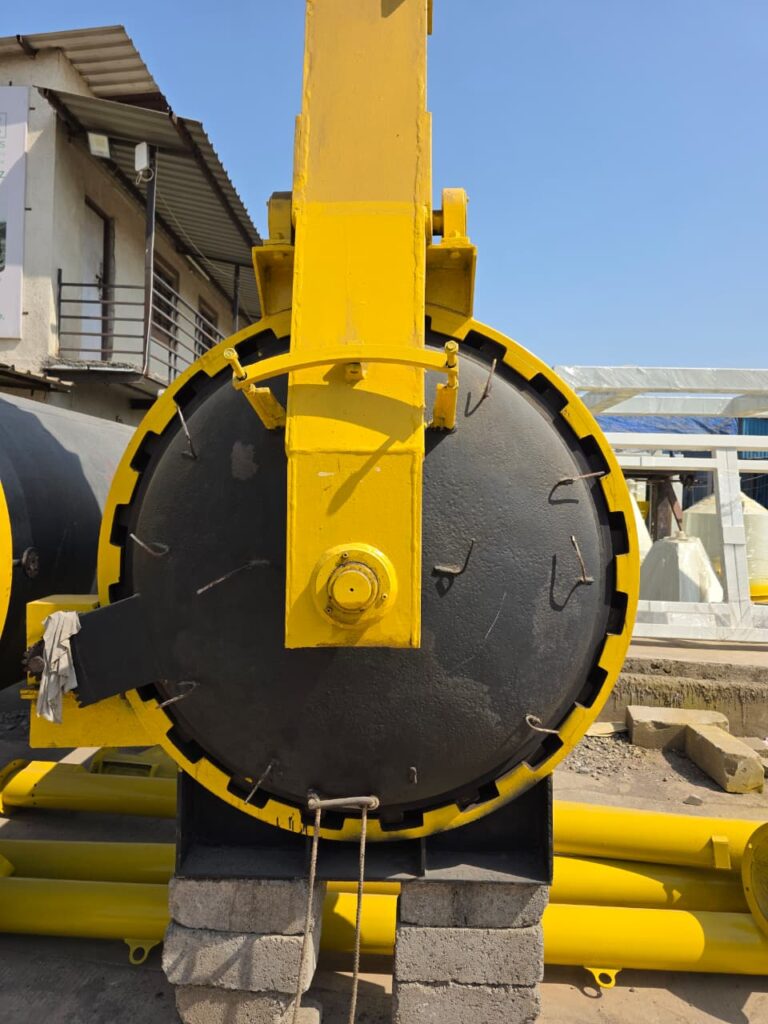
- Autoclave: It is the most important equipment from the AAC Production because they keep “green cakes” in a large pressure vessel called autoclave. Here, under high temperature and pressure steam, the blocks are cured and gain their final strength, durability, and properties.
- Block Gripper/Stacking Machine: These machines are fully automated to lift and stack the finished AAC blocks or panels onto pallets for transport and storage once the blocks undergo autoclaving, removing as much manual labor as possible and enhancing productivity.
Conclusion
An AAC plant is an extensive complex of interlinked systems managed by various specialized equipment devices. This includes everything from the primary crushing and grinding of raw materials through to the final autoclave treatment of high-pressure steam curing: they all contribute equally in an essential way toward producing lightweight, strong, and energy-efficient blocks widely used today in modern construction through an extremely careful process.