
AAC block production process in Uganda
- Home
- About Us

We’re a global award wining company
AAC Block Production Process in Uganda: A Step Towards Sustainable Construction
Autoclaved Aerated Concrete (AAC) blocks are really changing the global construction industry, even in Uganda. Made from a mixture of cement, lime, sand or fly ash, water, and a small quantity of aluminum powder, these blocks are lightweight, durable, and highly energy-efficient. Growing demand for environmentally friendly and affordable building materials is being created with the rapid expansion of Uganda's construction industry. Furthermore, the use of AAC blocks minimizes construction time and enhances sustainability by lessening the use of natural resources and energy consumption. As Uganda is bent on putting more resources on modern infrastructure development, AAC blocks contribute significantly to the making of stronger, greener, and affordable structures.
We’re a global award wining company
What Are AAC Blocks?
Autoclaved Aerated Concrete (AAC) blocks are innovative, lightweight building materials meant to replace traditional clay bricks and concrete blocks. They are made using a mix of cement, lime, sand or fly ash, water, and a small amount of aluminum powder, which during curing forms millions of tiny air pores. This distinctive composition that imparts to the AAC blocks its signature properties-lightweight, strong, and highly insulating. Unlike conventional bricks, AAC blocks provide excellent thermal insulation, soundproofing, and fire resistance, thus making themselves highly suitable to the climates and growing infrastructure demands of Uganda. Being detachable, faster to install, and easier to work with has naturally led to the acceptance of AAC blocks among builders and contractors alike. These are energy-efficient options, hence, further collaborating toward eco-friendly construction across the length and breadth of Uganda.
Step-by-Step AAC Block Production Process in Uganda
- The Preparation of Rate Material
The production of Autoclaved Aerated Concrete (AAC) blocks in Uganda commences with thorough preparation of the raw materials. The constituents include cement, lime, fly ash (or sand), water, and aluminum powder. The quality of these materials can never be overemphasized because they directly influence the strength and durability of the final product. The use of high-quality cement and lime will, therefore, ensure that their chemical reactions take place swiftly to produce a strong, stable block structure. Similarly, the fly ash or sand meets the silica requirements for the reaction with lime during autoclaving to give calcium-silicate hydrates, which is the only source of strength in the block.
- Mixing and Slurry Formation
When all the raw materials have been prepared, they are accurately weighed and mixed. This is important for developing a product with uniformity. First, all solids-cement, lime, and fly ash/sand-are mixed. Then, water is added to this dry mix, along with the aluminum powder, to form a homogeneous, free-flowing slurry. The mixture here is not just combined; it is basically engineered in such a way that slurry-a prepared suspension-is designed to promote an even progression of chemical reactions in it, especially the one involving aluminum powder.
- Pouring and Pre-curing
The homogeneous slurry is then poured into large pre-lubricated molds. Here, once cast into the molds, the transformation begins. The aluminum powder is reacting with calcium hydroxide from the cement and lime, thereby generating millions of minute hydrogen gas bubbles. These bubbles make the slurry expand and rise like dough, forming a “cake.” Pre-curing is said to take place when this reaction hardens this mixture into a semi-solid sponge with a uniform distribution of tiny air pockets. It is indeed this porous structure that gives AAC blocks their weight and insulating capacity.
- Cutting Process
After pre-curing, the semi-solid AAC cake is carefully stripped from the mold. The material is relatively soft and easy to cut at this point. The cutting of the big cake into blocks of desired dimensions, including standard-sized bricks or larger wall panels, is carefully carried out using special machines fitted with steel wires. Accuracy during cutting is very important in blocks maintaining dimensional stability; an important consideration during construction for efficiency and quality purposes. Any error or variation in cutting could cause complications during wall construction, such as uneven joints and wastage of mortar.
- Autoclaving (High-Pressure Steam Curing)
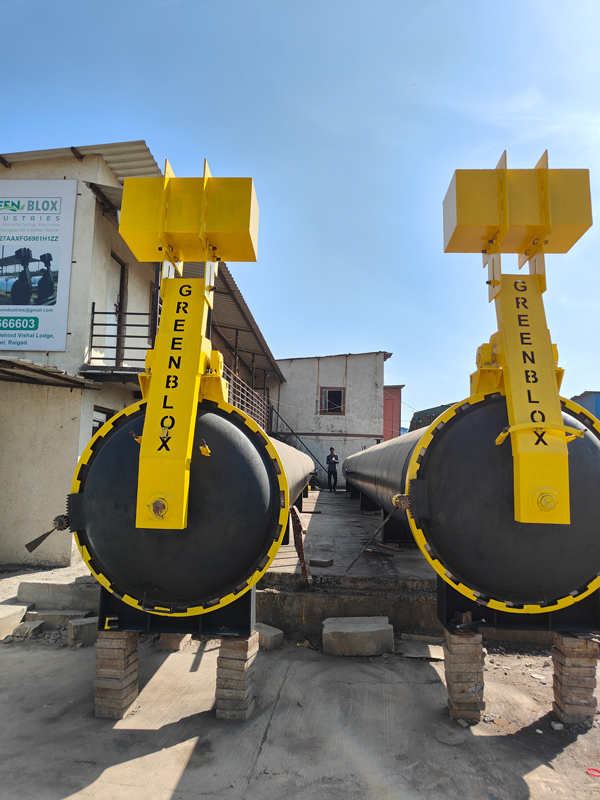
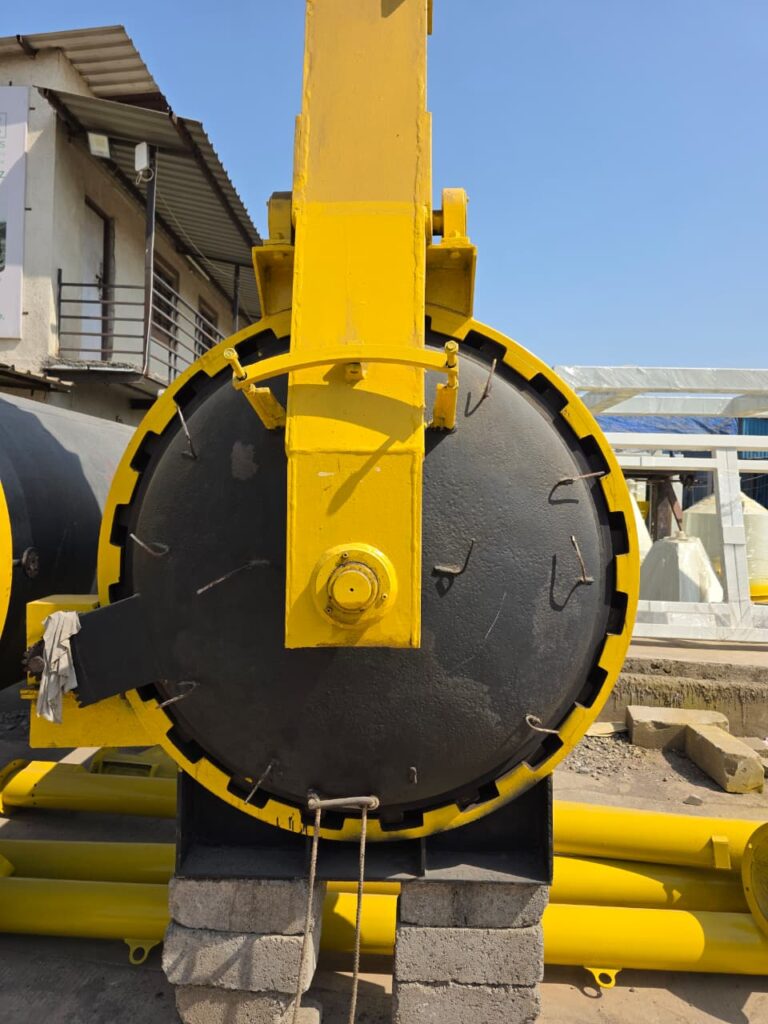
This must be the most crucial stage in the production process. The cut blocks are placed into large sealed pressure vessels known as autoclaves. Within the autoclaves, the blocks are exposed to high-pressure saturated steam at temperatures around 190°C and at 12-13 bar pressure for several hours. The autoclave curing under high pressure accelerates the reactions that convert the raw materials into a primarily crystalline structure. It is this crystallization process that bonds the particles together, deriving their high compressive strength, outstanding durability, and dimensional stability. Autoclaving essentially alters the properties of materials such that the blocks are strong enough for structural applications while still retaining their lightweight and insulating properties.
- Quality Control & Packing
Lastly, very rigid quality control and packing are done. Upon autoclaving, blocks pass through an inspection to ensure compliance to the required standards of strength, density, and size. Samples are taken for laboratory testing of compressive strength and other physical properties. This guarantees that the blocks are durable and viable for use in construction works in Uganda. Once they are deemed okay, the blocks will be stacked-in some cases with a protective wrap-and prepared for onward movement to site. The detailed quality control procedure ensures that the end product is a high-performance building material, fit for immediate use.
Why AAC Block Production is Growing in Uganda
- Need for Affordable Housing and Supporting Infrastructure
The rapid urbanization and population growth of Uganda have significantly increased the need for housing and infrastructural development. Emerging nations such as Uganda consider AAC blocks as low-cost and lightweight solutions in place of traditional building materials like clay bricks. Besides enhancing the speed of construction, the blocks have been viewed as desirable in income housing as well as in large projects for reducing labor costs.
- Government Commitment to Sustainable Construction
Indeed, environmental benefits provided by AAC blocks are included in the increasing prominence given to green growth and sustainable development by the Ugandan government. Energy and raw material required to produce AAC are substantially less than that of conventional bricks. AAC also provides the opportunity to use industrial waste such as fly ash in the manufacture of bricks, thus complementing the nation’s efforts in climate change mitigation and greening economy through encouraging the promotion of sustainable practices in building construction.
- Benefits of AAC in Uganda’s Climate
There are several benefits imported AAC blocks bring to a tropical country like Uganda. Their structure is porous with good thermal insulation and keeps the interior cool, thus leading to a reduction in the need for air conditioning, which would significantly save energy consumption in the long run. Their low weight minimizes the structural loads on buildings and makes transportation easier, which leads to further savings in overall construction costs. Fire-resistant, longer durability, and enhanced safety qualities are other advantages of AAC blocks.
- Local Manufacturing Reduces Dependency on Imports
So, localizing the AAC block manufacturing units is another prominent driver of the growth of AAC blocks across the globe. Manufacturing such products domestically saves much of the cost and trouble of importing AAC construction materials. Along with increasing local availability and affordability for builders, such developments step up the local economy by creating jobs and strengthening the domestic construction supply chain.
Conclusion
AAC block production in Uganda involves a sophisticated, multi-stage manufacturing process that transforms a simple mixture of cement, lime, fly ash, water, and aluminum powder into a lightweight, strong, thermally efficient building material. Each step-from the preparation of quality raw materials to high-pressure autoclaving-is carefully controlled in order to produce an even and high-performing end product. The resulting AAC blocks are becoming more desirable in the Ugandan construction industry because of their speed of construction, energy efficiency, and durability, making them a more sustainable alternative to conventional building materials.