
AAC Block Manufacturing Plant in Egypt
- Home
- About Us

We’re a global award wining company
AAC Block Manufacturing Plant in Egypt - Complete Guide
These AAC blocks are not only lightweight but are also eco-friendly and energy-efficient, and they are changing the face of construction in Egypt. These blocks are a precise formulation of cement, lime, sand, and aluminum powder and provide the best thermal insulation, soundproofing, and fire resistance, making them ideal for use in Egypt, where there are modern building requirements and climatic conditions. The country is experiencing an evolving state of rapid urbanization, which at an even higher rate contributes to increased residential, commercial, and industrial development projects; hence the need for developing sustainable and cost-effective construction materially materially influence influence and andersen . Therefore, to satisfy this increasing demand, advanced AAC manufacturing plants in Egypt are not only necessary but also passed on to faster production, consistent quality, and even contribute to green building initiatives for the country.
We’re a global award wining company
This is what an AAC Block is.
An AAC (Autoclaved Aerated Concrete) block is a lightweight, precast construction material that is best characterized by its strength-to-weight ratio and its excellent insulation. It consists of a combination of cement, lime, sand, water, and a small percentage of aluminum powder, which is the agent that causes the chemical reaction with the lime and produces tiny air pockets or voids within the block. The air pockets provide a porous structure and yet a strong material. After molding, it is cured either in an autoclave or under extreme high-pressure steam for additional durability and stability. AAC blocks are mostly used for thermal insulation, soundproofing, fire resistance, and environment-friendly purposes. Compared to conventional clay bricks, these blocks are easier to handle and less time-consuming for construction purposes and also help save energy in buildings. In the emerging scenarios of construction taking place in Egypt, AAC blocks appear to be the best sustainable solution in both residential and commercial buildings.
AAC Block Manufacturing Plant Components
- Raw Material Storage and Handling System
This is the first step for the raw materials to be stored and conditioned. The system includes silos for the storage of principal ingredients such as cement, lime, and fly ash. The silos also have sensors to check material levels. A conveyor system, mostly in the form of screw conveyors or pneumatic systems, carries the raw materials from the silos to the dosing unit. A separate system is used to carry gypsum and aluminum powder, as both of these together are important for aeration in the blocks.
- Dosing and Mixing Unit
It is here at the dosing unit that an accurate dosage of all raw materials is measured. This is a very important factor in ensuring the quality and consistency of the AAC blocks. Very sophisticated control systems ascertain that the precise mixture ratio of cement, lime, fly ash, gypsum, water, and aluminum powder is met. The next step of transferring the dosed materials into a powerful mixer takes place. Inside, the materials are professedly mixed to a uniform slurry. The slurry is discharged into molds in readiness for the next step of production.
- Molding Section
In this section, the freshly mixed slurry is poured into large steel molds. To this point, the aluminum powder reacts with the other ingredients, producing countless tiny bubbles filled with hydrogen gas. This causes the slurry to expand upward, much like dough, forming a lightweight, porous “green cake”. This process of aeration gives AAC its ultimate low density and thermal insulation. Within a few hours, the cake firms sufficiently to be safely handled.
- Autoclaving Process (Steam Curing)
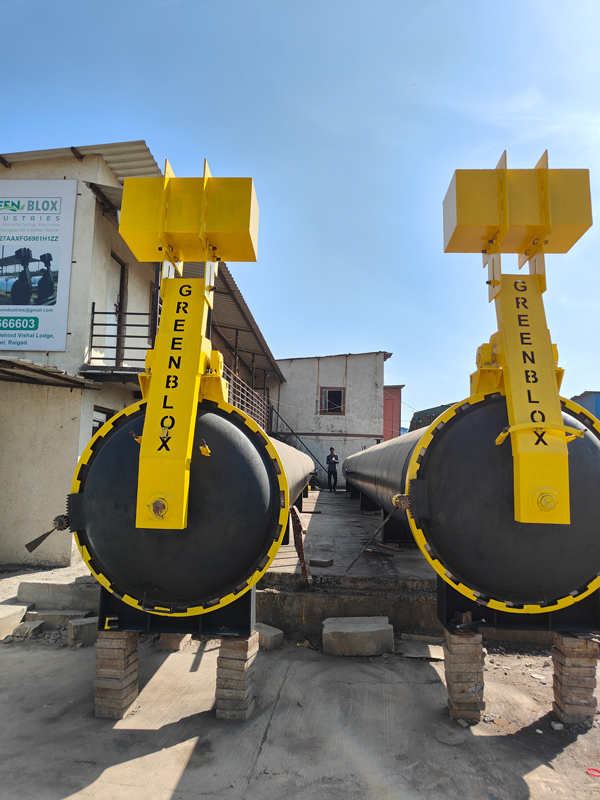
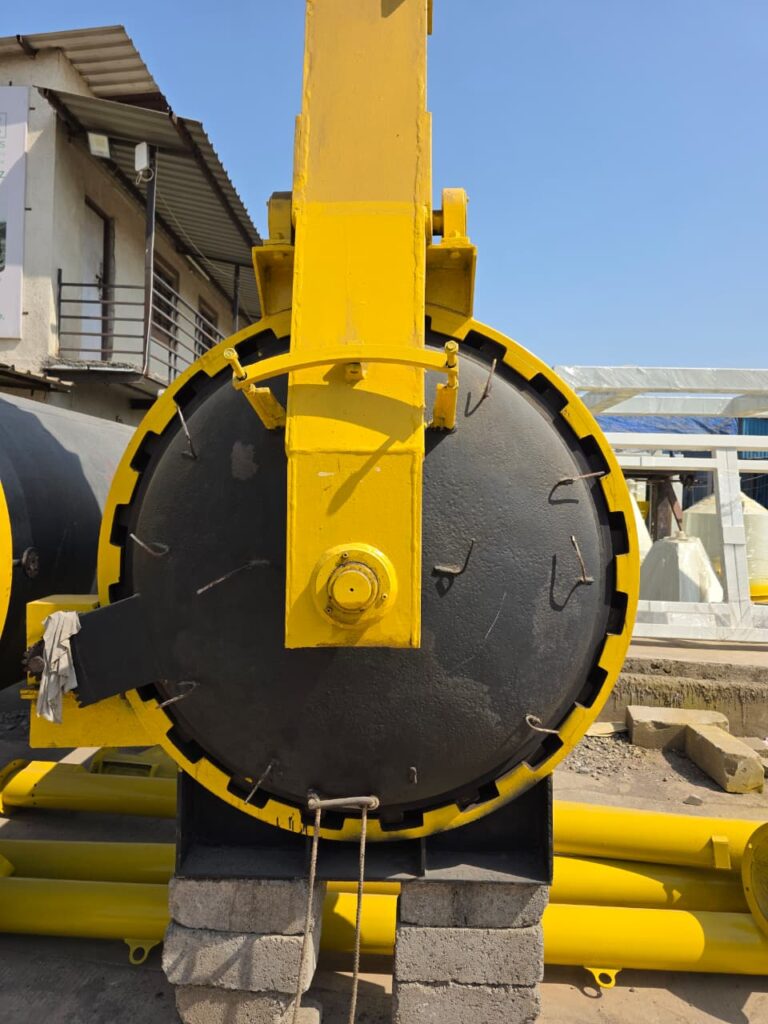
The cut green cakes now strong enough to be handled are moved to the autoclave. The autoclaving process is the most energy-intensive part. An autoclave is a pressure vessel of large cylindrical design in which blocks are subjected to high-pressure steam curing at temperatures of about 180–200°C (356–392°F) and pressures of 12–15 bars (174–218psi). This steam curing greatly speeds up the chemical processes within the blocks, converting a raw material lite structure into a stable crystalline structure of tobermorite, resulting in imparting high compressive strength and durability to the final AAC block.
- Cutting and Packaging Section
Cutting of the AAC blocks is done with the greatest precision by the exact cutting equipment with high-speed steel wires and saws to obtain the desired sizes after autoclaving. This includes standard blocks, U-blocks, and any custom-shapes required for specific applications. Subsequently, the finished blocks are palletized and wrapped and kept in preparation for storage or transportation. Packaging works to protect blocks during transit, a final quality inspection is often done here before being shipped to construction sites.
Steps in AAC Block Manufacturing Process
1.Preparation of Raw Materials
The first step of production consists of preparing the different raw materials, namely cement, lime, finely ground sand (or fly ash), water, and an aeration agent, which is conventionally aluminum powder. The sand is ground into a fine powder to provide smooth and uniform mixing. The aluminum powder reacts with calcium hydroxide in the cement-lime mixture and generates hydrogen gas. This creates millions of tiny disconnected air pockets that contribute to the lightweight and insulating properties of AAC blocks.
- Mixing and Pouring into Moulds
In this stage, the prepared raw materials are proportioned and mixed in a large mixer. Water is then added to form a slurry which is poured into large steel molds that are greased to avoid sticking with the mixture. This elevating action is very important in the development of the aerated structure of the blocks. The aluminum powder reacts with the calcium hydroxide, giving the mixture a rise like cake baking.
- Pre-curing Process
Once poured, the molds are kept in a warm environment for several hours under controlled conditions. This is termed pre-curing, or “rising,” or basically the hydrothermal reaction of the mixture. This reaction causes the slurry to expand and go from a liquid state to solid, but still “green” (uncured) cake type of material. This material is strong enough to be handled in a very careful manner, but it is not yet strong enough for actual construction.
- Cutting into Desired Sizes
After pre-curing, the large solid blocks are carefully demoulded and taken to the cutting machine. The cutting machine, usually fitted with tensioned steel wires, will then cut the massive green block cross-sectionally into individual AAC blocks of standard size and shape. Cutting precision is performed so uniformly that no variation arises from any dimension. Any cutting waste is recycled and added back into the next batch of raw materials.
- Autoclaving, Quality Checks, and Packaging
The final and most important stage is autoclaving. The freshly cut blocks are loaded on trolleys and brought inside a large high-pressure steam chamber named an autoclave. The blocks are then subjected to high-pressure steam (10-12 atmospheres) and high temperatures (around 180°C) in the autoclave for a few hours. The steam curing greatly speeds up the curing time and imparts strength, durability, and dimensional stability on the blocks. After autoclaving, the blocks are cooled, stacked, and made ready for dispatch. Quality checks are carried out at each stage of production with the foremost checks in this stage before packaging and dispatching to construction sites.
Conclusion
In conclusion, an AAC block manufacturing plant constitutes a well-integrated system comprising five main stages: raw material preparation, precise mixing, moulding with aeration, high-pressure steam curing, and final cutting and packaging. Each of these components is important to produce a good quality, lightweight, and durable building material. Careful control of each step is vital, especially when it comes to dosing and autoclaving, in order to guarantee that the final product possesses adequate strength and insulation properties in maintaining with modern construction specifications.